
Ottawa County Arrest Records and Court Charges
An Ottawa County arrest record is the account of the arrest itself. It shows who was taken into custody, who made the arrest, and when the booking took place. The Ottawa County Sheriff's Office holds this side of the story. The jail roster is the fastest public view of who sits in custody right now, and the booking detail lives there too. For the current in-custody roster and booking data, the Ottawa County inmate records page is the right stop. An arrest is only the start. It does not prove guilt, and it does not set the charges on its own.
The court charge record is a different file. Once a person is arrested, the Ottawa County Prosecuting Attorney reviews the reports and decides which court charges after arrest to file. Those charges enter the court record when a charging document is filed with the clerk. From that point the charges are tracked through the case as it is read, negotiated, and closed. The booking tells you a person was held. The charge record tells you what the state formally accuses the person of doing.
Charging Documents After an Ottawa County Arrest
The charge record begins the moment a prosecutor files a charging document with the court. That document names each offense and cites the law. In Michigan, three kinds of charging documents do this work, and the type used depends on how serious the offense is and how the case reaches the court. Most Ottawa County cases begin with a complaint, and felonies move onto an information after the district court finds probable cause.
| Complaint | Information | Indictment | |
|---|---|---|---|
| Filed by | Prosecutor, on a police request | Prosecutor | Grand jury |
| Common for | Misdemeanors and the start of felony cases | Felonies after bindover | Rare, serious matters |
| In Ottawa County | Read at the 58th District Court arraignment | Charges the case in the 20th Circuit Court | Uncommon; most felonies use the complaint and information path |
For a felony, the complaint starts the case in the 58th District Court, and the information formally charges it in the 20th Circuit Court once the case is bound over. A grand jury indictment is rare in county practice. Either way, the document a prosecutor files is what turns a booking into a court charge on the record.
Ottawa County Charge Codes and Severity Levels
Every charge on a court record is tied to a Michigan statute, shown as an MCL number, and carries a severity level. A felony is the most serious level and can carry prison time. A misdemeanor is a lower-level offense, handled in the 58th District Court unless it is joined to a felony. A civil infraction is not a crime at all; it is a fine-based violation, common with traffic tickets. One arrest can produce several separate charges, so a single case may list more than one count and more than one level.
- Charge
- The offense a prosecutor formally alleges against a defendant.
- Count
- One separate charge; a single arrest can produce several counts.
- Arraignment
- The first court appearance, where the charge is read and bond is addressed.
- Disposition
- The outcome of a charge or a case.
- Bindover
- A district judge's order sending a felony to the Circuit Court after a preliminary exam.
Reading the code and level tells you how the state views the offense. It does not tell you how the case ended. For that, you read the charge status and the final disposition.
How Ottawa County Charge Status Changes
Charges rarely stay fixed. As a case moves, a charge can be amended, reduced, added, dropped, or dismissed. A plea deal often reduces a charge to a lower level in exchange for a plea. The court record marks each of these moves, so the status you see today may differ from the charge read at the first hearing. The terms below show up often in Ottawa County case histories.
| Status | What It Means |
|---|---|
| Pending | The charge is filed and waiting for a result; no verdict or plea yet. |
| Amended / Reduced | The prosecutor changed the charge, often to a lower level as part of a plea. |
| Dismissed | The court dropped the charge, and it will not go forward. |
| Nolle Prosequi | The prosecutor formally chose not to pursue the charge. |
| Bound Over | A felony charge sent from the 58th District Court to the 20th Circuit Court after a preliminary exam. |
How to Find Ottawa County Arrest Records and Charges
The charges and their status show up in the state case search, while the booking side lives in the county jail roster. The 20th Circuit Court and the 58th District Court both post case history through the statewide portal. Start with the charge record and work from there.
- Open MiCOURT Case Search and pick the court, either the 58th District Court location or the 20th Circuit Court.
- Search by the defendant's name or by the case number if you have it.
- Open the case and read the charge list and the register of actions.
- Check each charge for its statute code, level, and current status.
Online results show case history, not scanned documents, because Michigan court rules keep document images off the public Internet. For the booking side, use the county Ottawa County inmate lookup to confirm who is in custody now. For people held in state prison, on parole, or on probation, the MDOC OTIS search is the right tool instead.
Ottawa County Charges vs. Convictions
Being charged is not the same as being convicted. A charge is what the state alleges at the start. A conviction is what a court finds proven at the end. The gap between them matters, because many charges are reduced, dismissed, or resolved without any conviction at all.
| Charge | Conviction | |
|---|---|---|
| Stage | Accusation | Verdict or plea |
| Burden of proof | Probable cause | Beyond a reasonable doubt |
| What it means | The state alleges an offense | A court finds the offense proven |
| Public record | Yes, unless restricted | Yes, unless set aside |
Note: A charge that is dismissed, reduced, or resolved without a conviction may still appear in the case history, so read the disposition before drawing any conclusion.
First Appearance and Felony Bindover to Circuit Court
After charges are filed, the first court appearance is the arraignment in the 58th District Court, which sits in Grand Haven, Holland, and Hudsonville. The judge or magistrate reads the charge, sets or reviews bond, and takes an early plea. Misdemeanor charges usually stay in the District Court through to their end. Felony charges take a longer road.
A felony gets a preliminary examination in the District Court. If the judge finds probable cause, the case is bound over to the 20th Circuit Court, where the prosecutor files an information and the felony is arraigned again. The path runs in a clear order.
Arrest and booking → Complaint filed → 58th District Court arraignment → Preliminary examination → Bindover → 20th Circuit Court arraignment on the information.
The charge record tracks the accusations. The pleas, motions, verdict, disposition, and sentence that finish the story live in the full Ottawa County criminal court records file.
Bond and Jail Status After an Ottawa County Arrest
Bond is addressed at the arraignment. The court can release a defendant on a promise to appear, set a cash or surety bond, or hold the person without bond in limited cases. While a person waits, the county jail roster shows the current in-custody status. Bond can be paid at the jail lobby kiosk, online, or by phone.
Jail data moves fast. A booking record can change within hours as people are released, transferred, or charged. Posted identity is confirmed only by fingerprint, and an arrest still does not equal a conviction. Treat the roster as a snapshot, and call the jail if a result looks unclear.
Warrants and Failure-to-Appear Issues
Charges and warrants often cross paths. When a defendant misses a scheduled court date on a District Court or Circuit Court charge, the judge can issue a bench warrant for failure to appear. A warrant can also follow a probation violation or a failure to pay as ordered. The warrant then attaches to the same case that holds the charge.
Ottawa County does not run a public online warrant list, so a warrant is confirmed through the court on the case, not through a search page. Look for a failure-to-appear or bench-warrant entry in the case history, then contact the court location tied to the case before appearing.
Important: Do not rely on a private aggregator to confirm a warrant; official verification comes only from the court on the case, the Sheriff's Office, or the jail.
Requesting an Ottawa County Arrest or Booking Report
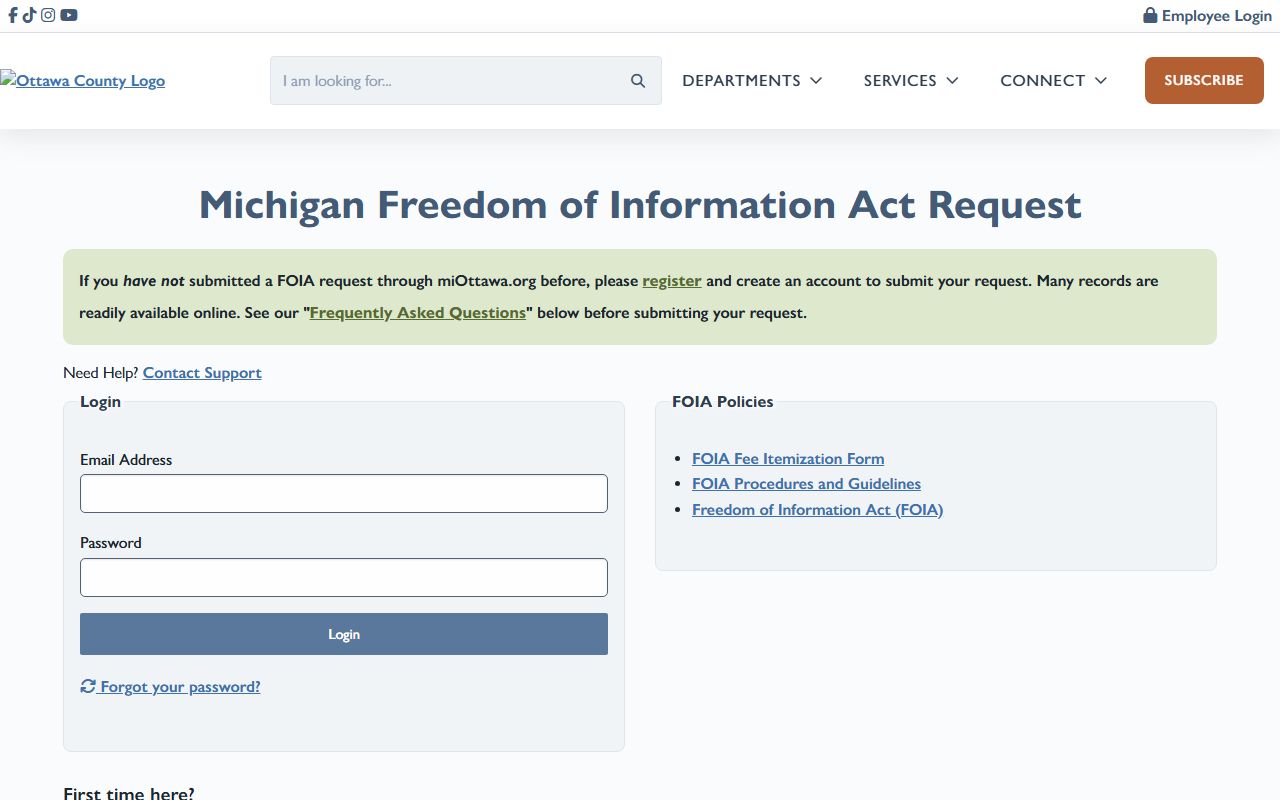
The court charge record and the underlying arrest report are held by different offices. The arrest and booking report is a sheriff record, not a court file, so it is requested under the Michigan Freedom of Information Act through the Sheriff's Records Unit or the county public-records portal. The Ottawa County FOIA Center is the online route for submitting that request.
The Ottawa County FOIA Center portal lets a requester register and file for sheriff reports and other county executive records.
Written requests can also reach the Sheriff's Records Unit by mail, fax, or in person, and reports are not ready at the moment of the request. Michigan gives a public body five business days to respond, with a possible ten-business-day extension. The Michigan Attorney General FOIA guidance explains those deadlines and how to frame a request.
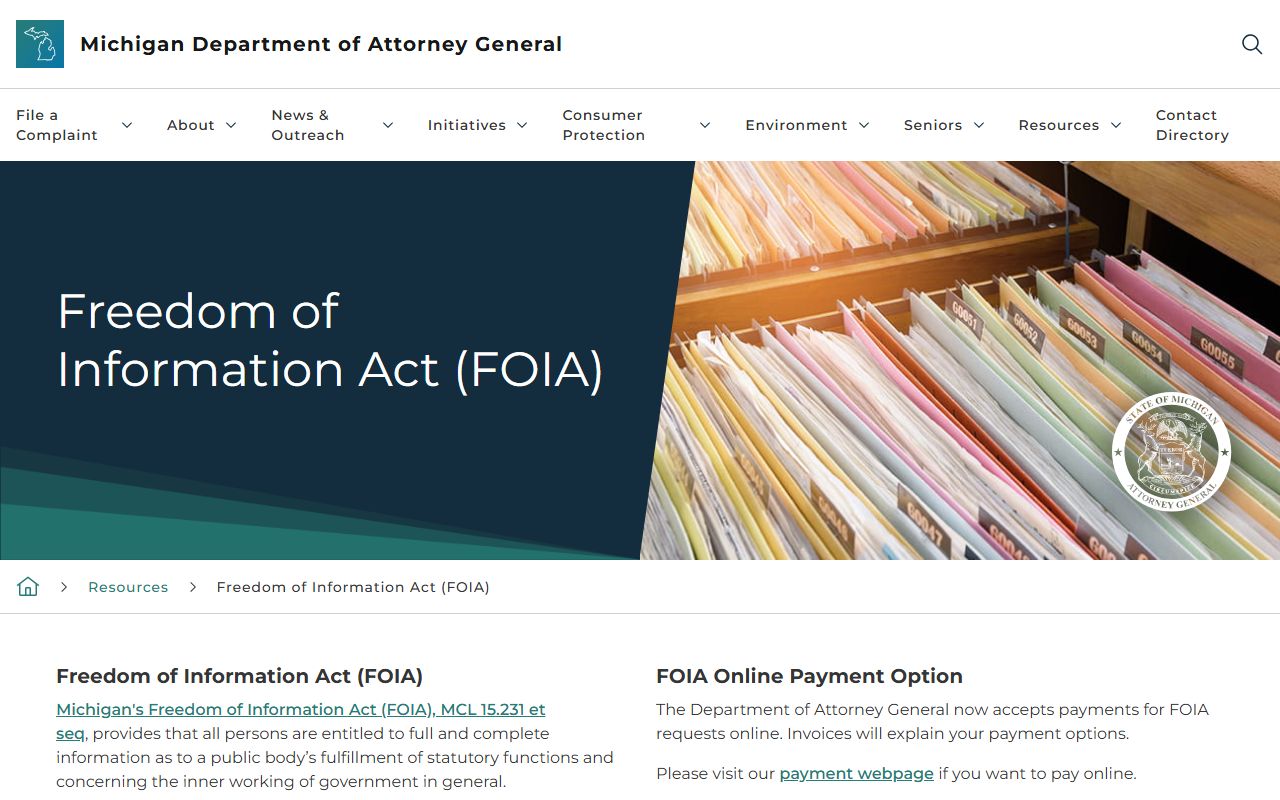
The guidance is worth reading before you file, because a request that names the report, date, people, and case or report number is answered faster than a broad question.
Public Access Laws for Ottawa County Charge Records
Court charge records follow Michigan Court Rules, chiefly MCR 8.119, rather than ordinary county FOIA. Under that rule, case history can appear online, but document images are not published on the public Internet. To read or copy an actual filing, a person contacts the clerk or uses a public-access terminal at the courthouse. Court sittings themselves are open to the public under MCL 600.1420.
Sheriff arrest reports fall under a different law. The Michigan FOIA statute declares a public policy that favors access to the records of public bodies, and it is the route for county executive records like a booking report.
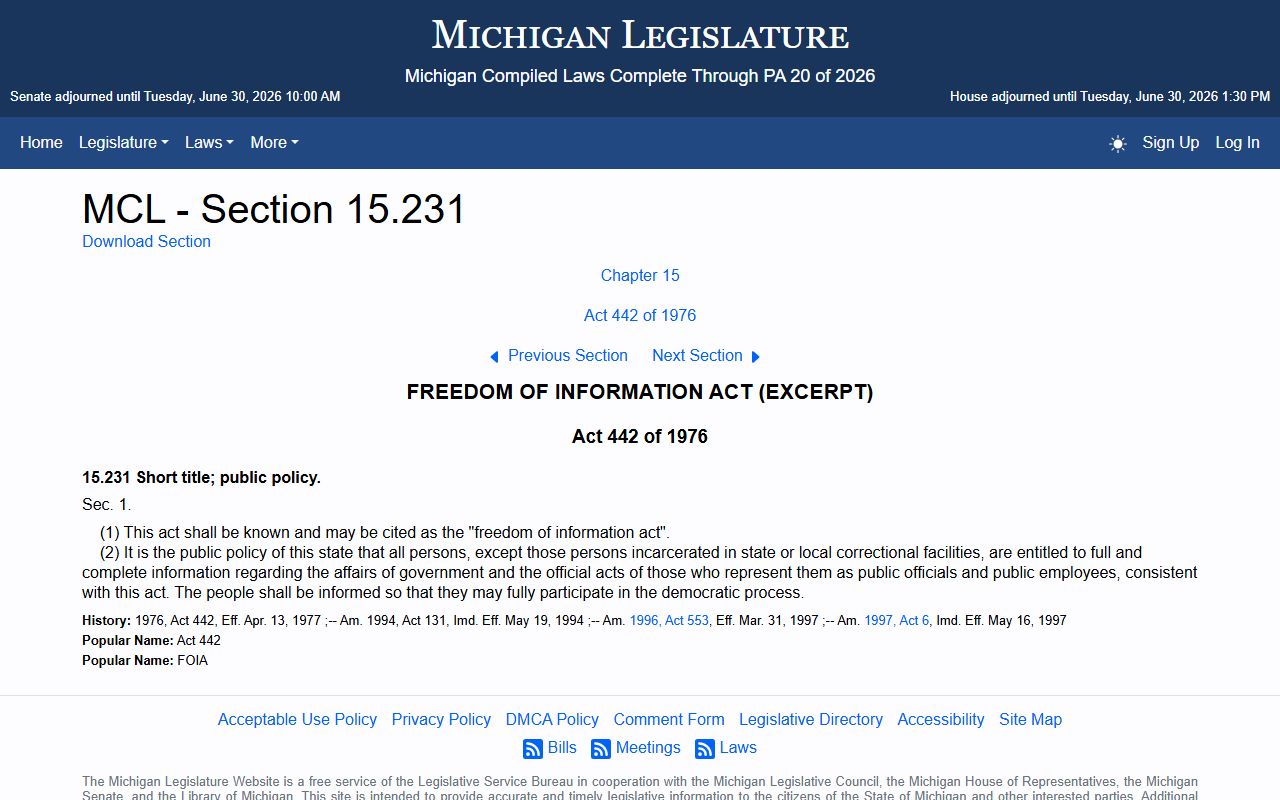
That statute governs the sheriff side of the file, while court rules govern the charge side, and keeping the two apart saves time.
Note: A court charge is searched under court rules through MiCOURT, while a sheriff arrest report is requested under Michigan FOIA, so the two paths are not the same.
Restricted Charge Records in Ottawa County
Not every charge is open to the public. Juvenile charges are restricted, and access is limited to parties, agencies, and others with a statutory reason or a court order. The Michigan juvenile record access statute, MCL 712A.28, sets those limits, so a public search may not show a minor's case at all.
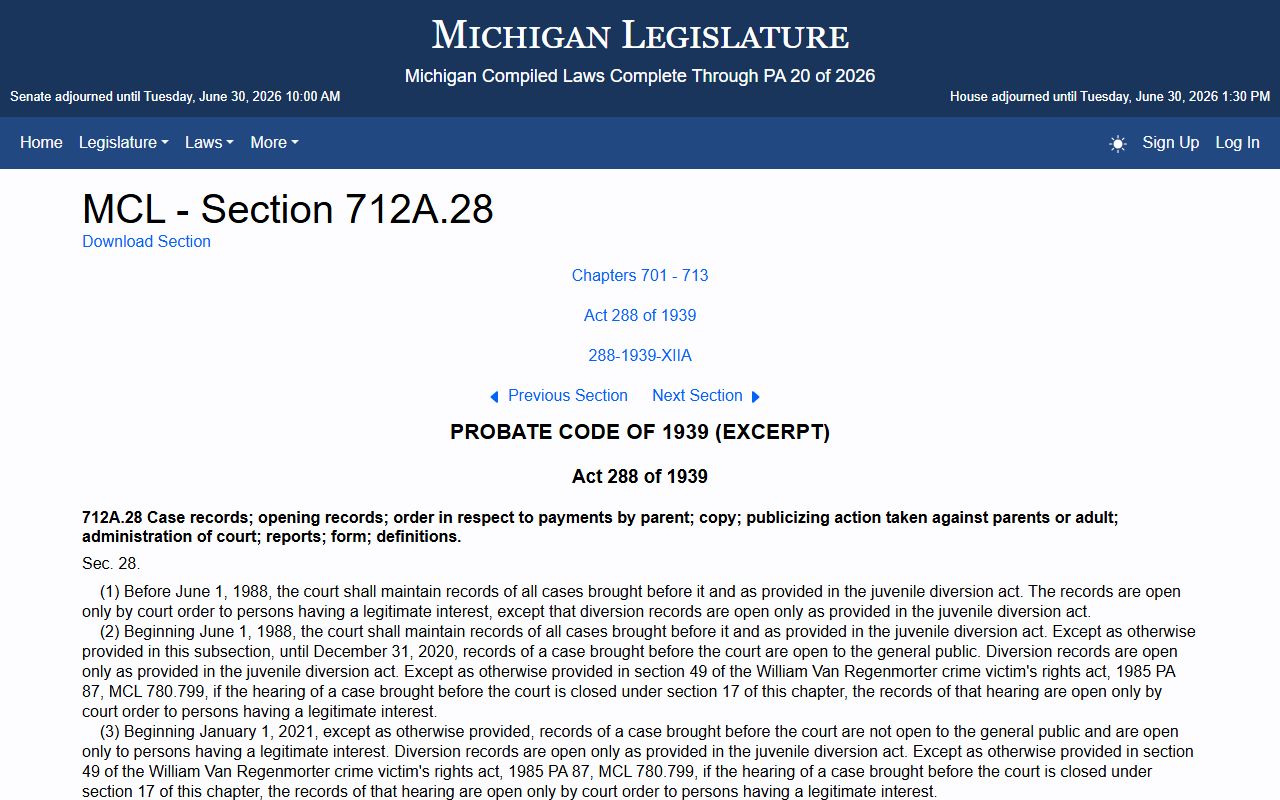
Adoption files, sealed cases, and set-aside convictions are also held back from ordinary public search. Michigan's Clean Slate program can set aside eligible convictions after a waiting period, which then drop from public view. A missing result for a minor or a sealed matter is not proof that no case exists, so do not read an empty search as a clean record.