
Criminal Court Records in Ottawa County
A criminal court record is the case file a court keeps once charges are filed against a person. In Ottawa County, that file opens the moment a criminal case is started in court. The clerk of the court that handles the case builds and holds it. The file grows as the case moves. Each event adds a new entry, from the first appearance to the last order. A complete record can name the charges, the parties, the judge, the hearings, and the outcome. It is a case-level record, not a police blotter.
Criminal cases in Ottawa County are split between two trial courts. Misdemeanors and the early steps of a felony are handled by the 58th District Court. Felonies move up to the 20th Circuit Court after a step called bindover. Each court keeps the records for the cases it hears. For a closer look at the charges themselves, the Ottawa County arrest records and court charges page breaks down how a charge is filed and how it can change.
Ottawa County Courts That Handle Criminal Cases
Felony cases follow a set path through the Ottawa County court system. A felony starts in the 58th District Court, where the first appearance, bond, and a probable-cause or preliminary examination take place. If the court finds enough proof to move forward, the case binds over to the 20th Circuit Court for trial and sentencing. The 20th Circuit Court is the county's main trial court for serious crimes, and it also handles felony pleas and post-judgment matters.
Misdemeanors stay in District Court from start to finish. The 58th District Court hears them at its Grand Haven, Holland, and Hudsonville locations. This split matters for a records search. A felony can leave entries in both courts, while a misdemeanor lives in one District Court file.
The court that holds the file is the court that provides its copies, so a search starts by naming the right court first.
How to Search Ottawa County Criminal Court Records
Ottawa County criminal cases are searched through MiCOURT Case Search, the state's public case-search portal. Both the 20th Circuit Court and the 58th District Court post case history there. The search runs court by court, so the right court is picked first. Results show case history, not scanned documents.
- Open MiCOURT Case Search and pick the court. Choose the 20th Circuit Court for a felony or the 58th District Court location for a misdemeanor.
- Search by the defendant's name, or by the case number when it is known.
- Narrow the results by case type and date to sort out common names.
- Open the case to read the register of actions, charges, hearings, and disposition.
- Request a certified copy from the Circuit Court Records office or the correct District Court location when a paper copy is needed.
MiCOURT shows case history, but it does not post document images. Michigan court rules keep scanned court documents off the public Internet. To read or copy an actual filing, a person visits a courthouse public terminal or asks the clerk. Some cases are limited too. Minor defendants, adoptions, and sealed files may not appear in an online search.
Stages of an Ottawa County Criminal Case
A criminal case moves through set stages, and each stage adds to the record. The file starts with the charge and ends with a sentence if there is a conviction. Reading the stages in order helps a person make sense of the entries in the case history.
Case flow: Charges Filed › Arraignment › Pretrial / Motions › Plea or Trial › Disposition › Sentencing
| Stage | What Happens |
|---|---|
| Arraignment | The defendant is told the charge and enters a first plea. Bond or release conditions are set. |
| Pretrial / Motions | Lawyers exchange information, file motions, and may reach a plea deal before trial. |
| Plea or Trial | The case ends in a plea, or a judge or jury decides guilt at trial. |
| Sentencing | After a conviction, the judge imposes a sentence, which can include jail, probation, fines, or restitution. |
The register of actions lists these events by date, so the record reads as a timeline of the case.
How Charges Are Filed in Ottawa County
Charges in Ottawa County are filed by the Ottawa County Prosecuting Attorney, not by the police. The current Prosecuting Attorney is Sarah F. Matwiejczyk. Her office reviews the reports that officers submit and decides whether a crime should be charged. Police make arrests, but the prosecutor decides what charges, if any, go to court.
The office serves as the chief administrator of criminal justice for the county. It advises law enforcement, reviews search warrants, interviews witnesses, and argues the case in court. When the office authorizes a felony, the case begins in the 58th District Court and later binds over to the 20th Circuit Court. A charge is only an accusation at this stage.
Note: An entry showing a filed charge means the prosecutor brought an accusation, not that a court has found the person guilty of any offense.
What an Ottawa County Criminal Court Record Shows
An Ottawa County criminal court record holds a mix of case facts and event history. Some fields identify the case and the people in it. Others track what the court did and how the case ended. The table below breaks down the fields a person sees most often.
| Field | What It Shows |
|---|---|
| Case Number | The court's unique ID for the case, used to pull the file. |
| Defendant | The person charged, listed by name in the public case summary. |
| Charges | The offenses filed, with their level and statute where shown. |
| Plea | The defendant's answer to each charge, such as guilty, not guilty, or no contest. |
| Disposition | The outcome of each charge, such as convicted, dismissed, or acquitted. |
| Sentence | The penalty imposed after a conviction, including jail, probation, fines, or restitution. |
Public case history may also list the judge, hearing dates, bond, motions, and the full register of actions. It does not include scanned documents. Fines, costs, and restitution can show up as case financials in some records.
Reading Dispositions and Sentences
The disposition is the outcome of a charge, and it is the field most people look for. A charge can end in more than one way. Reading it right keeps a person from confusing an accusation with a conviction.
- Guilty: the defendant admitted the charge or was found guilty.
- Not guilty: the defendant was acquitted after trial.
- Dismissed: the charge was dropped by the court or the prosecutor.
- No contest: the defendant did not admit guilt but accepted the penalty.
- Deferred or diverted: the case may be dismissed later if the terms are met.
A sentence follows a conviction and sets the penalty. In Ottawa County records, a sentence can include jail or prison time, probation, fines, court costs, and restitution to a victim. Probation adds court-ordered supervision in the community. The record may also note credit for time already served in the county jail.
Charges vs. Convictions in Ottawa County Records
Being charged is not the same as being convicted, and a criminal record shows both. A file can list a charge that was later dropped, dismissed, or ended in acquittal. That entry stays in the public case history even when there is no conviction. Reading the disposition next to each charge is the only way to know the result.
| Charge | Conviction | |
|---|---|---|
| Stage | Accusation | Verdict or plea |
| Burden of Proof | Probable cause | Beyond a reasonable doubt |
| Who Decides | Prosecutor files it | Judge or jury finds it |
| Public Record | Yes | Yes |
A long charge list on a record does not prove guilt. Only the disposition does that.
Bonds, Fines, Costs, and Restitution
Money terms run through many Ottawa County criminal records. Bond is set early to secure the defendant's return to court. It can be cash, a surety bond posted by a bonding company, or release on conditions. The amount and type appear in the case history for many cases.
After a conviction, the court can order fines, court costs, and restitution. Restitution repays a victim for losses tied to the crime. The Ottawa County Prosecuting Attorney's Victim Assistance Unit helps victims seek restitution and stay informed about the case. Payment status can show up in the record or in a separate court payment system, depending on the court and case type.
Public Access to Ottawa County Criminal Court Records
Criminal court files in Ottawa County are public records, open under Michigan court rules. Court hearings are open too, unless a judge closes them for a legal reason. The main access rule is not the county FOIA law. Court case records follow the Michigan Court Rules instead.
A person can view public case history online through MiCOURT. Document images stay offline under those rules. To copy a filing, a person contacts the clerk or uses a courthouse public terminal. County records outside the court file, such as sheriff reports, go through the county FOIA process rather than the case search.
Key Statutes:
Michigan Court Rule 8.119 - Criminal court records are accessed under court rules, and document images are kept off the public Internet.
MCL 600.1420 - Court sittings in Michigan are open to the public unless a legal exception applies.
Sealed vs. Set-Aside Ottawa County Criminal Records
Not every criminal record stays public forever. Michigan lets some records be sealed or set aside, which pulls them from ordinary public view. The two are not the same. A sealed record is hidden by court order or rule. A set-aside conviction is treated under law as if it had been removed from the public record.
Michigan's set-aside statute spells out when and how a conviction can be cleared from public view.
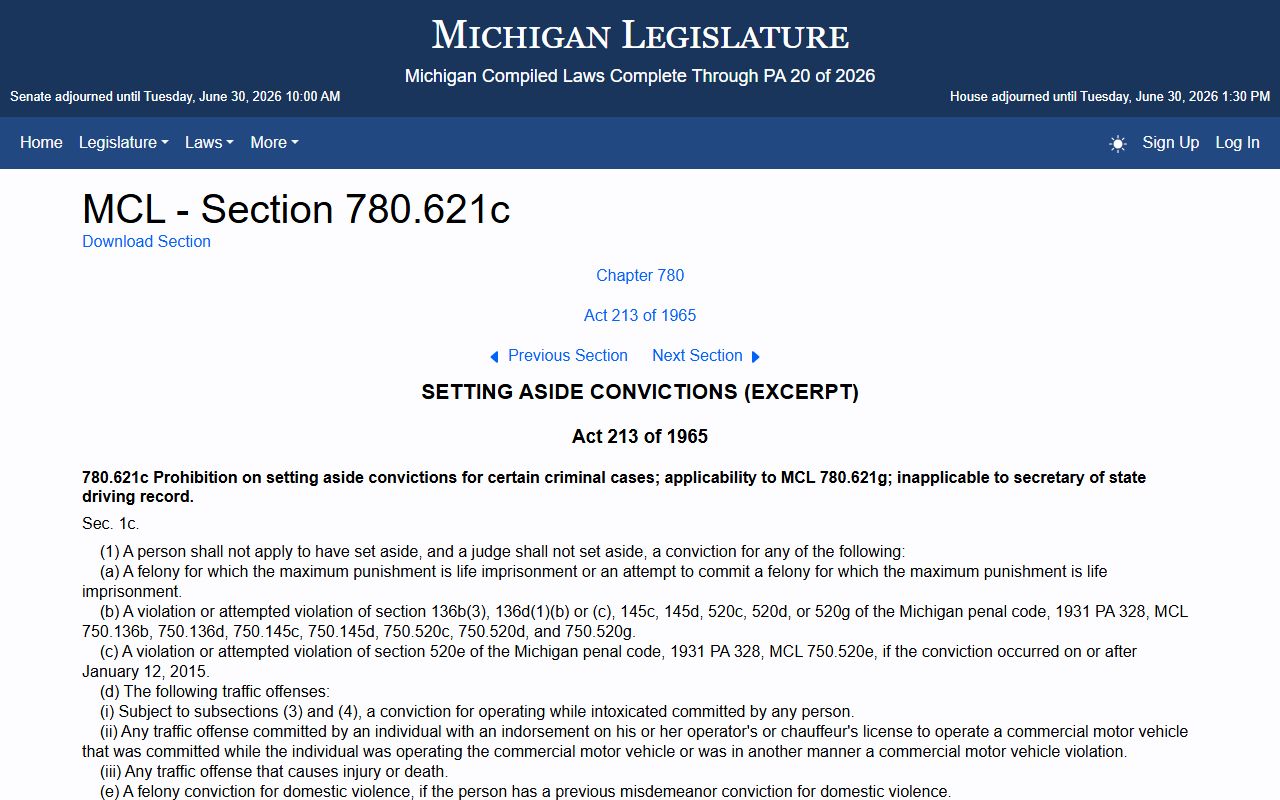
The statute lists waiting periods, eligible offenses, and the steps to file a set-aside request in the court of conviction.
| Sealed | Set Aside | |
|---|---|---|
| Visibility | Hidden from public search | Treated as removed from the public record |
| Law Enforcement | Limited access remains | Access may remain by statute |
| How It Happens | Court order or court rule | Application or automatic under Clean Slate |
| Eligibility | Case-specific, judge decides | Set by statute and waiting period |
In Ottawa County, a set-aside conviction no longer shows in an ordinary public court search, though law enforcement and certain agencies may still see it.
Michigan Clean Slate and Restricted Ottawa County Records
Michigan's Clean Slate law changed how convictions get set aside. Some records now clear on their own after a waiting period. Others still need an application filed in the court of conviction.
The Michigan State Police explain how the Clean Slate program sets aside eligible convictions.
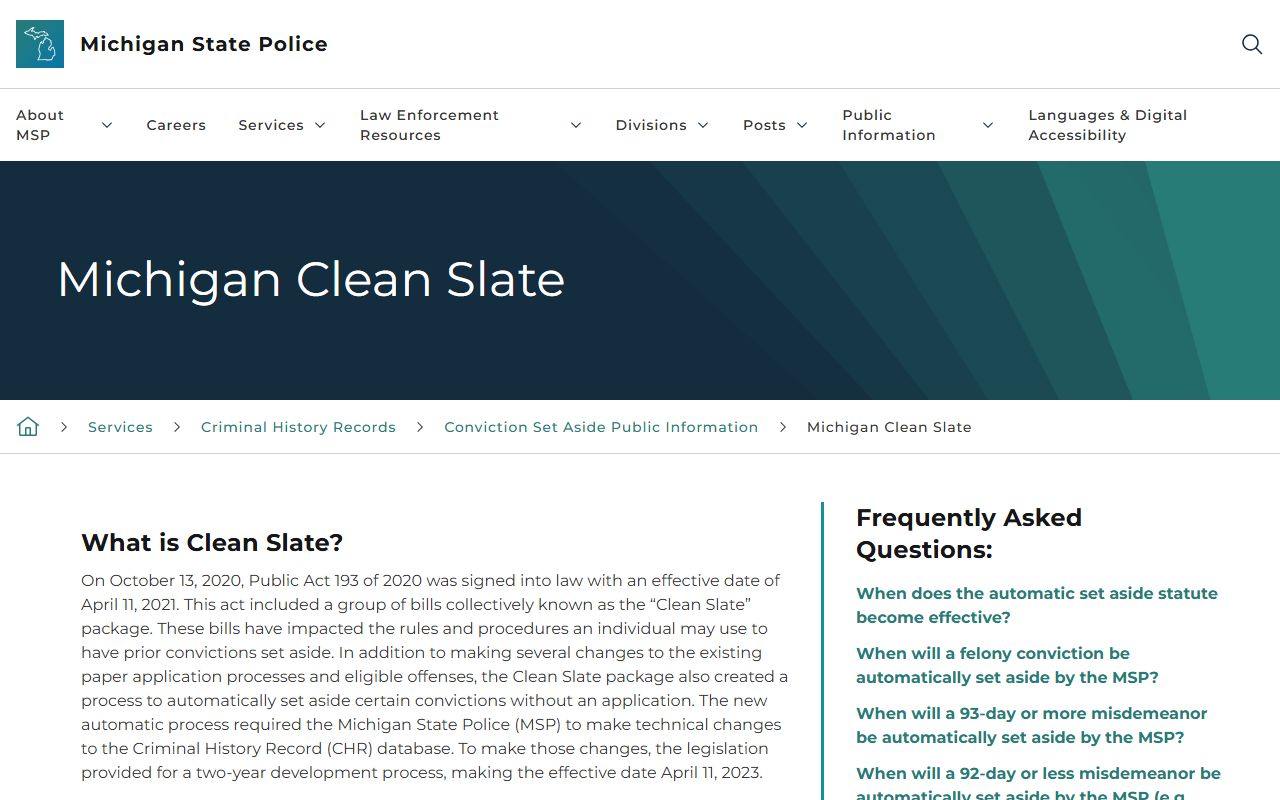
Under the program, eligible misdemeanors can be set aside automatically after seven years, and eligible felonies after ten years. The automatic path does not cover every crime. Assaultive offenses, serious misdemeanors, many dishonesty crimes, and traffic offenses such as OWI are left out. For those, a person must apply, meet the waiting period, and follow the fingerprint and service rules.
Other Ottawa County criminal records are restricted from the start. Juvenile cases are limited under MCL 712A.28 and often will not appear in a public search. Sealed files, adoption records, and cases involving minor defendants may be withheld or shown only in part.
Note: A missing MiCOURT result for a minor does not prove that no case exists, since many juvenile records are closed to the public by law.
Ottawa County Public Defender and Victim Services
Two offices shape many Ottawa County criminal cases and leave marks in the record. The Ottawa County Public Defender represents adults who cannot afford a lawyer. The current Public Defender is Philip R. Sielski. The office rests on the Sixth Amendment right to counsel and works out of Grand Haven and Holland.
On the other side of a case, the Victim Assistance Unit supports crime victims. It shares charge and court-rights information, helps with restitution, and gives input on plea or trial decisions. Victim notices and restitution can appear in the case chronology. For the full set of court files beyond criminal cases, the Ottawa County court records page covers civil, family, and probate matters as well.