
Ottawa County Marriage Records
Marriage records in Ottawa County are vital records, not court case files. The Clerk/Register of Deeds Vital Records Division creates and keeps them. This is the same elected office that handles concealed pistol licenses, deed recording, and elections. Justin F. Roebuck serves as the current County Clerk/Register of Deeds. When a couple gets a license and marries, the signed license comes back to the clerk, who records it and can then issue certified copies of the marriage.
A marriage record proves that a wedding took place and gives the legal date and place. People use certified copies to change a name, add a spouse to insurance, apply for benefits, or settle an estate. Ottawa County holds marriage records going back to the 1800s. The office where you apply for a license is the same office that later sells you the certificate, so the whole life of a marriage record runs through the clerk. Broader clerk services are covered on the Ottawa County Clerk of Court page.
Note: Marriage records are handled by the clerk as vital records, while divorce records are held by the circuit court as case files, so the two follow separate request paths.
How to Apply for a Marriage License
The license must be issued before the wedding, and it comes from the clerk, not the court. Both people apply together and each must be at least 18 years old at the time of application. Michigan residents apply in the county where one of them lives. Out-of-state couples apply in the Ottawa County office that serves the place where the wedding will happen. Plan ahead, because the license does not take effect the same day.
- Confirm both applicants are 18 or older and gather proof of identity and date of birth for each person.
- Visit an Ottawa County Clerk vital records location together, since both parties sign the application.
- Provide names, birth dates, and the details the clerk needs, and review the required educational materials on disease transmission and prevention.
- Pay the license fee at pickup by cash, money order, Visa, or MasterCard.
- Wait out the three-day waiting period unless you qualify for a waiver, then collect the license and marry within the allowed window.
Ottawa County Marriage License Waiting Period
Michigan sets a three-day waiting period after the application before the license can be issued. The rule gives couples a short pause between applying and marrying. Ottawa County can waive those three days if the couple shows one accepted proof at the time they apply. The waiver is not automatic, so bring the document with you if you need to skip the wait.
Waiving the three-day wait. The county may drop the waiting period when a couple presents one of these at application: a notarized clergy statement showing when the marriage will be solemnized, a professional wedding invitation (computer-generated invitations are not accepted), a newspaper announcement, or military deployment papers.
Timing also runs the other way. The marriage must take place within 33 days from the date of application. The county warns couples not to apply more than 33 days before the wedding date, or the license may expire before the ceremony. A license that lapses cannot be used, and a new application would be needed. Line up the application date so it falls inside that 33-day window.
Ottawa County Marriage and Divorce Fees
Fees split by record type. The marriage license fee depends on residency and is paid at pickup. Certified marriage copies carry a flat first-copy fee, with a lower price for extra copies of the same record ordered the same day. Divorce fees are court fees, so they follow the circuit court schedule instead. The table below pulls the main amounts together.
| Item | Amount |
|---|---|
| Marriage license (Michigan residents) | $20 |
| Marriage license (out-of-state residents) | $30 |
| Certified marriage copy (first) | $15 |
| Certified marriage copy (each additional, same record, same day) | $6 |
| New divorce or custody case filing | $230 |
| Certified divorce copy | $10 plus $1 per page |
The $25 e-filing fee applies to new circuit court cases where e-filing is used. Machine copies at the circuit court run $1 per page. The Circuit Court Records Division does not accept personal checks, so plan another payment method for divorce copies.
Certified Copies of Ottawa County Marriage Records
You need a certified copy for most official uses, such as a name change or a benefit claim. Ottawa County sells certified marriage copies in person at any clerk location. In-person payment can be cash, check, money order, Visa, MasterCard, or Discover. The first certified copy costs $15, and each additional copy of the same record ordered the same day costs $6.
Mail requests work too. Send the Application for Certified Marriage Record along with a check or money order made payable to Ottawa County Clerk. The county warns applicants not to mail requests to any other location. Use the West Olive vital records office below as the mailing address.
Ottawa County Clerk - West Olive Vital Records
12220 Fillmore Street, Room 130
West Olive, MI 49460
(616) 994-4531
Monday-Friday 8:00 a.m.-5:00 p.m.
Note: Certified copies are required for most legal and government uses, while uncertified prints or informational copies are generally not accepted for those purposes.
Ordering Ottawa County Marriage Records Online
The county runs an online portal for ordering certified vital records without a trip to the counter. The Ottawa County vital records portal lists marriage record ranges of October 29, 2019 to present, 1913 to October 28, 2019, and 1848 to 1912. Each order is $15 and includes one certified copy, with additional copies of the same record on the same order at $6 each. A technology fee applies, fees are non-refundable, and orders are processed and mailed within five business days.
A quick look at the portal shows how ordering works from start to finish on the county vital records ordering site.
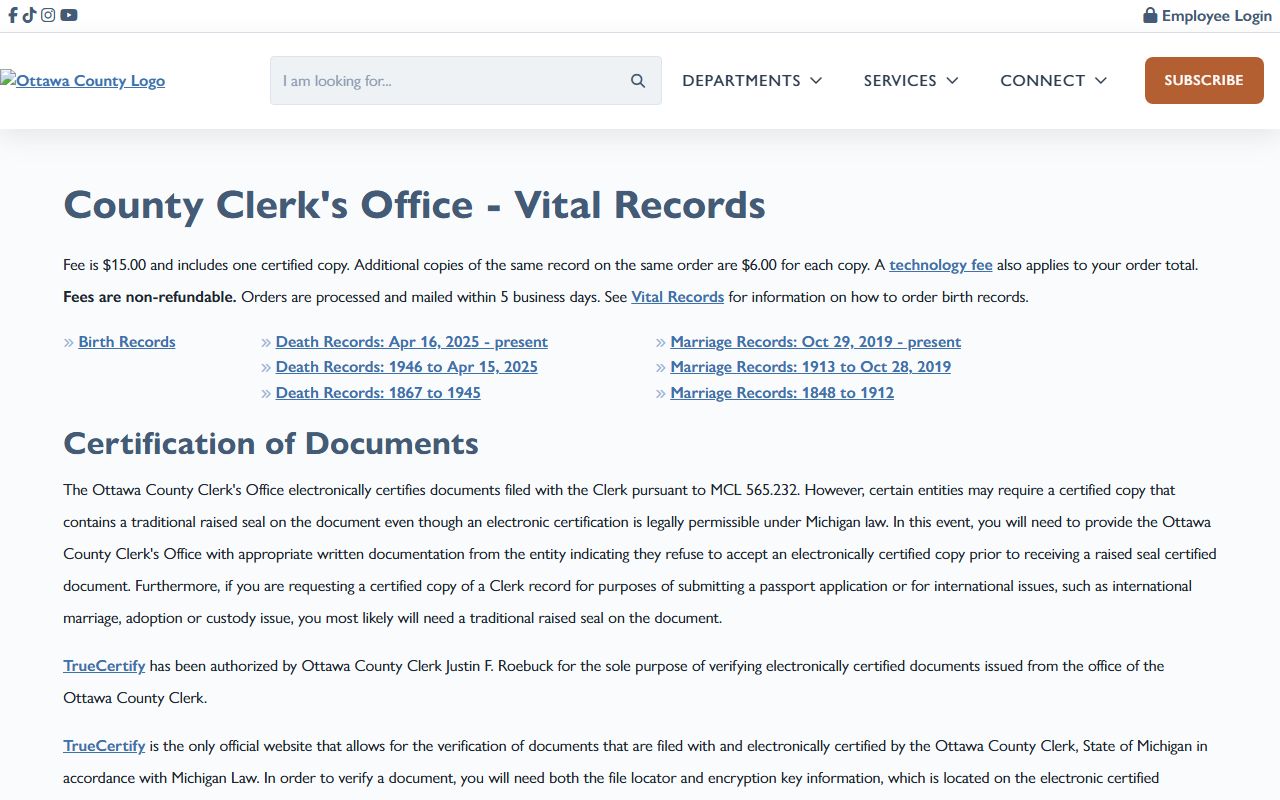
The screen walks you through record choice, eligibility, identity, and payment before it accepts the order. The table below lists the fields and steps the portal asks for.
| Field / Step | Required | Notes |
|---|---|---|
| Record type and date range | Yes | Marriage date ranges are shown, along with birth and death record choices. |
| Eligibility acknowledgement | Yes | The portal requires you to confirm eligibility before ordering. |
| Applicant identity and ID upload | Yes | A government ID upload is required. |
| Mailing address | Yes | Must match the ID unless a utility bill is provided. |
| Additional copies | No | $6 each for the same record on the same order. |
| Payment | Yes | $15 certified copy plus a technology fee. |
| TrueCertify verification | Only for verification | Uses a file locator and encryption key to verify electronic certification. |
Ottawa County Divorce Records Are Circuit Court Records
Divorce records do not sit at the vital records counter. A divorce is a court case, so the file lives with the 20th Circuit Court, the trial court that handles divorce, custody, and support in Ottawa County. To find case history, search the statewide MiCOURT Case Search. That tool shows public case information, though some details tied to families and minors are limited.
When you need the actual file or a copy of the judgment, contact the county Circuit Court Records Division. A divorce file can include the complaint, the judgment of divorce, and orders on custody, parenting time, and support. Michigan is a no-fault state, so a spouse does not have to prove wrongdoing to end a marriage. The full range of case documents is described on the Ottawa County court records page.
20th Circuit Court Records Division
414 Washington Ave, Room 320
Grand Haven, MI 49417
(616) 846-8315
circuitcourtrecords@miottawa.org
Ottawa County Divorce Filing and Copy Fees
Starting a divorce carries a court fee, and copies of the outcome carry their own charge. A new divorce or custody case costs $230, plus the $25 e-filing fee where e-filing applies. Certified copies are $10 plus $1 per page. Every copy of a judgment of divorce must be certified, so there is no plain-copy option for that document. Plain machine copies of other pages run $1 per page.
People who file without a lawyer can use the county Legal Self Help Center. Its divorce forms page offers ready packets for common situations.
- Divorce Without Children
- Divorce With Children
- Motion Requesting Order of Non-Paternity
Remember that the Circuit Court Records Division does not take personal checks. Bring cash, a money order, or a card when you order certified divorce copies at the counter.
Public and Restricted Ottawa County Divorce Records
Most marriage and divorce records are open to the public, but not every detail is. Family cases often involve minor children, financial accounts, and protected identifiers. Michigan court rules and statutes keep some of that material out of ordinary public view. So a divorce may appear in a public case search while parts of the file stay limited.
Sealed orders and cases with protected personal information may not show online or at the counter. Adoption files are treated as confidential, and juvenile matters are restricted under Michigan law. Records that touch mental-health proceedings can also carry restricted access. When a record does not appear where you expect, the limit is usually the law, not a gap in the system. Contact the Circuit Court Records Division to ask about a lawful access path when a family file is not fully visible.
Note: A public case search may show that a divorce exists while sealed orders, minor-child details, and protected identifiers within the file remain unavailable to the general public.